
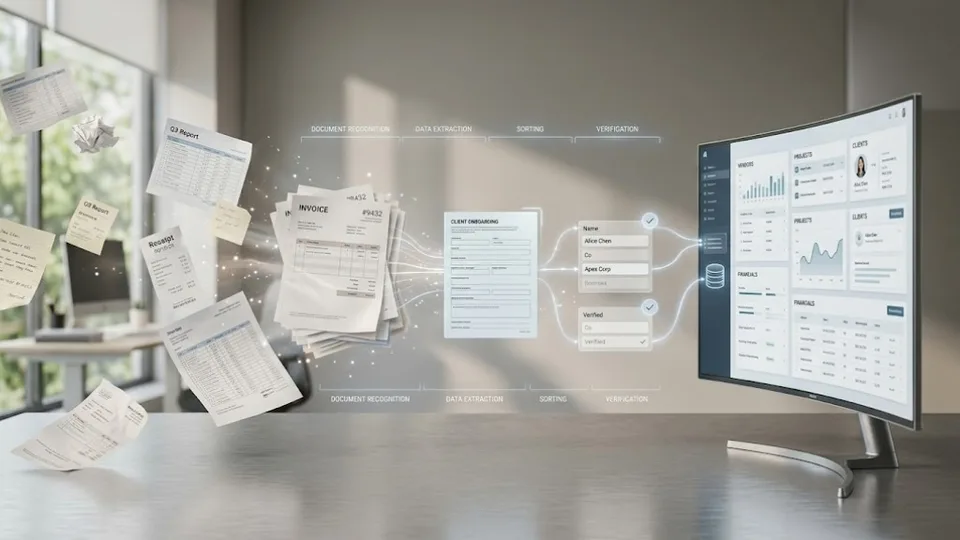
AI Data Entry Agent: How AI Data Entry Automation Helps Businesses Save Time, Reduce Errors, and Improve Operational Efficiency
Introduction
Almost every business depends on data.
Customer details, inquiries, invoices, orders, appointment information, service requests, sales
records, spreadsheets, internal documents, forms, and operational updates all generate data every single day. The challenge is not collecting data. The challenge is entering that data accurately and consistently. Manual data entry often looks simple, but it creates major hidden costs.
It consumes staff time, introduces avoidable mistakes, slows workflows, and pulls teams away
from higher-value work. That is why more businesses are adopting the AI Data Entry Agent.
An AI Data Entry Agent is an intelligent system designed to capture information, organise it,
process structured inputs, and automatically enter relevant data into business systems with minimal manual effort.
If you have searched for terms like AI data entry, data entry automation, AI data processing,
automated data entry software, or AI business process automation, this guide explains how
AI data entry agents work, why they matter, and how they help businesses improve speed,
accuracy, and operational scalability.
What Is an AI Data Entry Agent?
An AI Data Entry Agent is an AI-powered operational assistant built to automate repetitive data
input tasks.
Its role is simple but highly valuable: move information into the right place without relying
entirely on manual entry.
Instead of asking staff to repeatedly copy, type, update, or organise information manually, an AI
- Capture information from incoming workflows
- Organise data into structured fields
- Update business systems automatically
- Reduce repetitive manual input
- Support high-volume information handling
- Improve consistency across records
- Reduce operational bottlenecks
In simple terms, it helps businesses process data faster and more accurately.
Why Data Entry Becomes a Business Problem
Many companies underestimate how much time disappears into repetitive admin work.
Data entry often happens across:
- customer inquiries
- forms
- spreadsheets
- CRM updates
- appointment systems
- invoices
- internal records
- lead management systems
When done manually, common problems include:
- human error
- missing fields
- inconsistent formatting
- delayed updates
- duplicated information
- lost productivity
That is why businesses increasingly search for:
- AI data entry automation
- automated data processing
- AI business automation
- AI workflow automation
They want better operational efficiency without increasing admin workload.
How an AI Data Entry Agent Works
An AI data entry agent connects to the points where business information is created.
This may include:
- emails
- online forms
- spreadsheets
- documents
- customer inquiries
- order requests
- service workflows
- internal operational processes
When new information appears, the AI can:
1. Detect relevant data
2. Extract important fields
3. Structure the information properly
4. Enter the data into the correct system
5. Update records automatically
6. Trigger workflow continuity if needed
For example:
A customer submits an inquiry.
The AI data entry agent can automatically record:
- customer name
- contact details
- service request
- date received
- inquiry category
That saves time and reduces manual admin.
Why Businesses Struggle With Manual Data Entry
Data entry usually becomes inefficient because it is repetitive.
Common business problems include:
- staff doing copy-paste work
- manual form transfers
- spreadsheet maintenance overload
- delayed updates during busy periods
- admin tasks competing with revenue-generating work
Over time, these small inefficiencies create larger operational drag.
Core Functions of an AI Data Entry Agent
Automatic Data Capture
The AI can identify useful information from incoming business activity and prepare it for entry.
Structured Data Processing
The AI helps organise information into consistent formats such as:
- names
- phone numbers
- dates
- categories
- statuses
- customer details
Consistency improves workflow quality.
System Updates
The AI can push information into the correct systems, such as:
- spreadsheets
- internal databases
- operational tools
- CRM platforms
- scheduling systems
This reduces repetitive human effort.
High-Volume Handling
One major advantage is scalability. As information volume grows, manual data entry becomes harder. AI handles larger volume much more efficiently.
Error Reduction Support
Manual typing often creates avoidable mistakes. AI data entry agents help reduce common data handling errors.
Benefits of Using an AI Data Entry Agent
Saves Time
Teams spend less time doing repetitive administrative tasks.
Reduces Human Error
Fewer manual inputs usually means better data accuracy.
Improves Workflow Speed
Information moves through systems faster.
Increases Operational Efficiency
Teams can focus more on higher-value work.
Supports Scalability
Growing businesses can process more information without proportional admin growth.
AI Data Entry Agents and Business Productivity
Many businesses do not realise how much productivity gets lost to repetitive operational work.
When employees spend large amounts of time entering data manually, they spend less time on:
- sales
- customer service
- client relationships
- problem-solving
- business development
An AI data entry agent helps reduce that administrative drag.
AI Data Entry Agents and Data Accuracy
Bad data creates downstream problems.
Inaccurate records often lead to:
- wrong follow-ups
- poor reporting
- workflow confusion
- customer service issues
- lost visibility
Cleaner data improves business reliability.
Industries That Benefit From AI Data Entry Agents
Healthcare
Patient forms, appointments, and service information create constant data flow.
Real Estate
Lead records, inquiry handling, and property workflows require structured updates.
Professional Services
Client records and project information often require consistent data handling.
E-commerce
Orders, customer details, and product workflows generate large volumes of operational data.
Finance and Accounting
Invoices, transactions, and client records often create repetitive admin.
High-Volume Service Businesses
Operational scale often creates data-entry bottlenecks.
Why Small Businesses Benefit From AI Data Entry
Automation
Small businesses often face resource constraints.
That means staff frequently handle:
- customer communication
- sales
- service delivery
- admin tasks
Manual data entry often becomes one of the biggest hidden productivity drains. An AI data entry agent helps smaller teams stay efficient without hiring extra administrative staff.
AI Data Entry and Workflow Consistency
One of the biggest hidden benefits is consistency.
The AI helps standardise:
- field formatting
- naming conventions
- categorisation
- update timing
- system accuracy
That creates smoother workflows across the business.
Common Use Cases of AI Data Entry Agents
Customer Inquiry Logging
Capture inbound lead details automatically.
CRM Record Population
Update customer records with less manual effort.
Form Processing
Move submitted form information into business systems.
Spreadsheet Updates
Automate repetitive spreadsheet entry.
Operational Record Management
Maintain internal records with better consistency.
Are AI Data Entry Agents Replacing Human Teams?
No. AI data entry agents support operational teams—they do not replace them.
Humans still remain essential for:
- decision-making
- exception handling
- process oversight
- relationship-driven work
- business judgment
The AI handles repetitive input. Humans handle thinking and execution.
What Businesses Should Look for in an AI Data Entry
Agent
A strong AI data entry solution should support:
- accurate information capture
- structured field organisation
- system integration flexibility
- workflow compatibility
- scalable volume handling
- minimal manual correction requirements
The goal is not just automation. The goal is cleaner and faster operations.
Common Mistakes Businesses Make
Assuming data entry is “small work” Small repetitive tasks create major long-term productivity loss.
Relying too heavily on manual copying
Manual transfer creates avoidable mistakes.
Letting operational updates lag behind
Delayed data often causes downstream inefficiencies.
Ignoring scaling pressure
As business volume grows, admin complexity grows too.
The Future of AI Data Entry
AI operational automation is advancing quickly.
Future capabilities may include:
- smarter field recognition
- stronger document understanding
- better cross-platform workflow integration
- more proactive process automation
- stronger exception detection
As businesses generate more information, intelligent data handling will become increasingly
important.