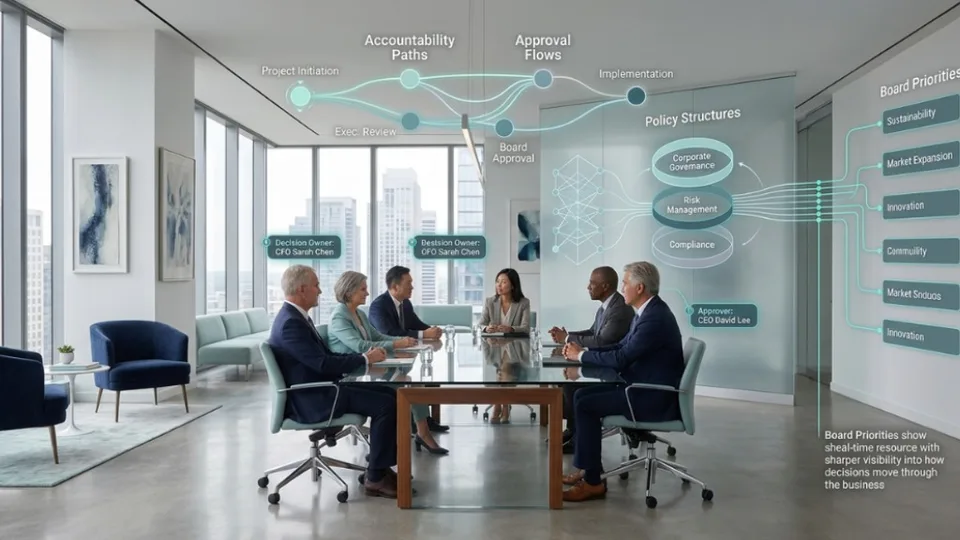
AI Governance Assistant: The Future of Intelligent Corporate Governance, Compliance Oversight, and Decision Intelligence
Introduction
Modern organisations operate in an increasingly complex environment where governance is no
longer just about leadership decisions—it includes regulatory compliance, ethical standards, risk management, ESG obligations, data privacy laws, and internal policy enforcement.
Traditional governance systems rely heavily on manual oversight, board reviews, spreadsheets,
and static reporting. This makes governance slow, reactive, and often disconnected from real-time business operations.
This is where the AI Governance Assistant is transforming organisational leadership and
control.
An AI Governance Assistant is an intelligent artificial intelligence system that supports
executives, boards, and compliance teams by monitoring governance processes, ensuring policy alignment, tracking risks, and generating real-time insights for better decision-making.
In this SEO-optimised guide, we will explore what an AI Governance Assistant is, how it works,
its features, benefits, applications, global keywords, challenges, and FAQs.
What is an AI Governance Assistant?
An AI Governance Assistant is an AI-powered system designed to support corporate
governance by monitoring compliance, analysing policies, tracking risks, and ensuring that organisational decisions align with legal, ethical, and strategic frameworks.
It uses advanced technologies such as:
- Artificial Intelligence (AI)
- Machine Learning (ML)
- Natural Language Processing (NLP)
- Regulatory Intelligence Systems
- Data Analytics Engines
- Policy Mapping Models
In simple terms:
It is a smart digital governance advisor that helps organisations make compliant, transparent,
and risk-aware decisions in real time.
Instead of relying only on manual board reviews, AI continuously supports governance with live
insights.
How Does an AI Governance Assistant Work?
The AI Governance Assistant operates through a structured governance intelligence workflow:
1. Data Collection
It gathers governance-related data from:
- Corporate policies
- Financial systems
- Compliance reports
- Risk management tools
- ESG and sustainability systems
- Internal communications
2. Policy and Regulation Mapping
AI aligns organisational policies with:
- Local and global regulations
- Industry standards
- Corporate governance frameworks
3. Continuous Monitoring
It monitors business activities to ensure governance compliance across all departments.
4. Risk and Compliance Analysis
AI identifies governance risks such as:
- Policy violations
- Regulatory breaches
- Ethical conflicts
- Financial irregularities
5. Decision Support Intelligence
Provides insights and recommendations to executives and boards.
6. Reporting and Visualisation
Generates governance dashboards and structured reports for leadership.
7. Alert System
Sends real-time alerts for governance issues or compliance failures.
8. Continuous Learning
Improves governance recommendations using historical data and outcomes.
Key Features of AI Governance Assistant
1. Real-Time Governance Monitoring
Continuously tracks organisational compliance and policy adherence.
2. AI Policy Alignment Engine
Ensures all business activities align with governance frameworks.
3. Risk Detection System
Identifies governance, financial, and ethical risks.
4. Board Decision Support
Provides insights for strategic leadership decisions.
5. Regulatory Compliance Tracking
Monitors compliance with global laws and standards.
6. ESG Governance Integration
Tracks environmental, social, and governance performance.
7. Automated Governance Reporting
Generates structured reports for executives and boards.
8. Ethical Risk Analysis
Detects potential ethical violations in operations.
9. Multi-System Integration
Connects with ERP, CRM, finance, and compliance systems.
10. Predictive Governance Intelligence
Forecasts governance risks before they occur.
Benefits of AI Governance Assistant
1. Improved Decision-Making
Provides real-time insights for better executive decisions.
2. Stronger Compliance Control
Ensures alignment with global regulatory frameworks.
3. Reduced Governance Risk
Identifies risks early before they escalate.
4. Enhanced Transparency
Improves visibility into organisational operations.
5. Faster Reporting Cycles
Automates governance reporting and documentation.
6. Better Board Efficiency
Supports board members with data-driven insights.
7. Cost Reduction
Reduces manual governance management efforts.
8. Continuous Oversight
Ensures 24/7 governance monitoring.
Applications of AI Governance Assistant
1. Corporate Boards
- Strategic decision support
- Governance oversight
- Policy enforcement
2. Financial Institutions
- Regulatory governance
- Risk oversight
- Compliance monitoring
3. Government Organisations
- Public governance tracking
- Policy enforcement
- Regulatory compliance
4. Healthcare Sector
- Clinical governance
- Data privacy oversight
- Compliance monitoring
5. Enterprises & Multinationals
- Internal governance management
- Global compliance tracking
- ESG governance
6. Legal & Compliance Teams
- Policy interpretation
- Regulatory alignment
- Legal governance support
7. ESG & Sustainability Teams
- ESG governance tracking
- Sustainability reporting oversight
- Ethical compliance monitoring
Why AI Governance Assistant is Important in 2026 and
Beyond
Corporate governance is becoming more complex due to globalisation, stricter regulations, ESG
requirements, and rapid digital transformation.
AI Governance Assistants solve this by:
- Providing real-time governance intelligence
- Automating compliance monitoring
- Supporting ethical decision-making
- Improving board-level visibility
- Reducing regulatory risk exposure
With increasing demand for transparency, accountability, and ESG compliance, AI
governance systems are becoming essential for modern organisations.
Challenges of AI Governance Assistant
1. Complex Governance Structures
Large organisations have multiple governance layers.
2. Data Integration Issues
Connecting all systems can be technically challenging.
3. Regulatory Diversity
Governance laws differ across countries.
4. Ethical Interpretation Limits
AI may struggle with subjective ethical decisions.
5. Data Privacy Concerns
Governance data must remain highly secure.
Future of AI Governance Assistant
The future of AI Governance Assistants is highly advanced, driven by:
- Autonomous governance systems
- Real-time global compliance intelligence
- AI-powered boardroom decision engines
- Generative AI governance reporting
- Predictive ethical risk models
Future capabilities may include:
- Fully autonomous governance frameworks
- AI-powered board advisory systems
- Real-time global regulatory adaptation
- Self-learning ethical decision engines
- Predictive corporate governance intelligence
Governance will evolve into a fully AI-driven, real-time organisational intelligence system.
Frequently Asked Questions (FAQs)
1. What is an AI Governance Assistant?
It is an AI system that supports corporate governance by monitoring compliance, risks, and
policy alignment.
2. How does an AI Governance Assistant work?
It collects data, analyses governance risks, and provides real-time decision support.
3. What are the benefits of AI Governance Assistants?
They improve compliance, reduce risk, enhance transparency, and support better
decision-making.
4. Can AI replace corporate boards?
No, AI supports governance but does not replace human leadership and judgment.
5. Is AI governance reliable?
Yes, when trained with accurate regulatory and organisational data.
6. Which industries use governance AI systems?
Finance, healthcare, government, enterprises, and ESG-focused organisations.
7. Does it support ESG governance?
Yes, it integrates environmental, social, and governance monitoring.
8. What is the future of corporate governance?
The future includes AI-driven, real-time, and predictive governance systems.
Conclusion
The AI Governance Assistant is revolutionising how organisations manage leadership
oversight, compliance, and ethical decision-making. By providing real-time governance intelligence, risk monitoring, and decision support, it enhances transparency, accountability, and organisational performance.
As global regulations and business complexity continue to increase, AI-powered governance
systems will become essential for sustainable and responsible enterprise management.
From corporate boards to governments and global institutions, this technology is shaping the
future of intelligent governance worldwide.
FEATURE POST:
AI Vendor Compliance Agent
AI Vendor Compliance Agent: The Future
of Automated Supplier Monitoring, Risk