
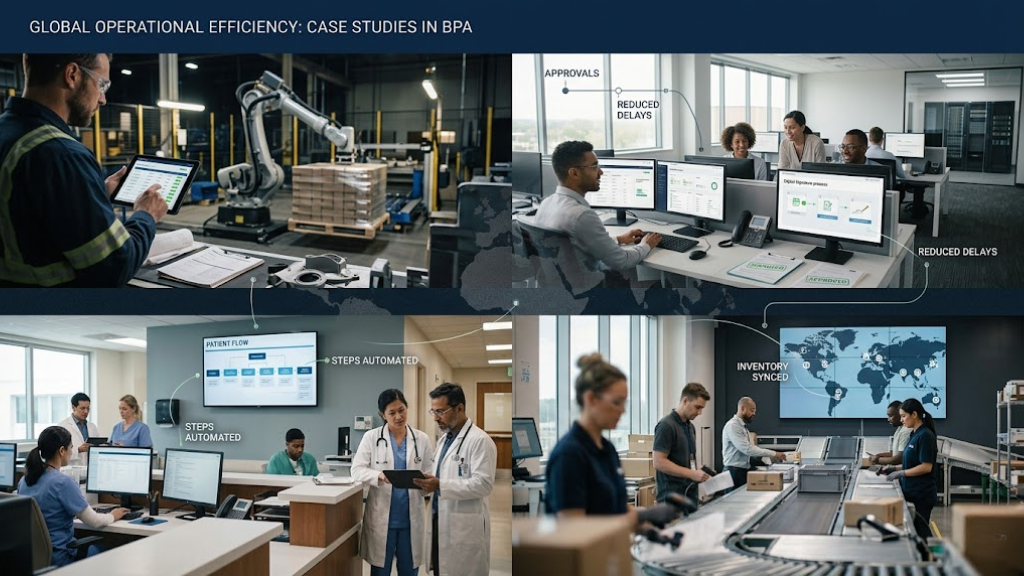
Business Process Automation: Real-World Examples and Case Studies from Global Enterprises
Introduction
In today’s fast-changing digital economy, businesses across the world are
rapidly adopting Business Process Automation (BPA) to improve efficiency, reduce costs, and scale operations intelligently. Organisations are no longer relying on manual workflows. Instead, they are shifting toward AI-driven automation systems that streamline decision-making and eliminate repetitive processes.
At Global AI Group, we specialise in designing and implementing
advanced business process automation solutions that help companies transform their operations into intelligent, self-optimising systems. Our focus is not just automation—but building scalable digital ecosystems powered by AI.
This article explores how global enterprises are using business process
automation in real-world scenarios, along with practical case studies that highlight measurable transformation outcomes.
What is Business Process Automation?
Business Process Automation (BPA) refers to the use of technology to
automate structured, repetitive, and rule-based business tasks. These tasks can span across departments such as finance, HR, operations, customer service, and supply chain management.
- Artificial Intelligence (AI)
- Machine learning models
- Workflow orchestration systems
- Data-driven decision frameworks
At its core, BPA allows organisations to move from manual execution to
intelligent, automated workflows that operate continuously with minimal human intervention.
Why Global Businesses Are Adopting Automation
Across industries, organisations are facing increasing pressure to:
- Improve operational efficiency
- Reduce human dependency in repetitive tasks
- Scale globally without increasing costs proportionally
- Deliver faster and more accurate services
- Gain real-time business insights
This shift has made AI-powered business process automation a
strategic necessity rather than an optional upgrade.
At Global AI Group, we see automation as the foundation of modern digital
transformation strategies.
Global Case Study 1: Financial Process Automation
A multinational financial services organisation faced delays in invoice
approvals, reconciliation errors, and inconsistent reporting across regions.
The Challenge:
- Manual invoice validation
- Multiple approval layers causing delays
- High error rates in financial reporting
The Solution by Global AI Group:
We designed an intelligent automation framework that digitised invoice
workflows, integrated approval systems, and introduced rule-based validation logic.
The Outcome:
- Significant reduction in processing time
- Improved accuracy in financial records
- Faster cross-border transaction approvals
- Enhanced financial visibility across departments
This transformation enabled the organisation to operate with higher
financial efficiency and compliance.
Global Case Study 2: HR & Employee Lifecycle
Automation
A global enterprise with distributed teams struggled with slow onboarding
processes and inconsistent HR workflows across regions.
The Challenge:
- Manual onboarding documentation
- Delayed account setup for new employees
- Lack of standardised HR processes globally
The Solution by Global AI Group:
We implemented an automated HR workflow system that streamlined
onboarding, document verification, and employee lifecycle tracking.
The Outcome:
- Faster onboarding cycles
- Standardised HR processes across all locations
- Improved employee experience
- Reduced administrative workload for HR teams
This allowed the HR department to focus more on strategic talent
development rather than operational tasks.
Global Case Study 3: Customer Service Automation
A global service-based company was facing increasing customer support
demand, leading to delayed response times and inconsistent service quality.
The Challenge:
- High volume of repetitive customer queries
- Slow response times during peak hours
- Inefficient ticket routing system
The Solution by Global AI Group:
We implemented an AI-driven workflow automation system that categorised
customer requests, prioritised urgent issues, and streamlined support routing.
The Outcome:
- Faster response times
- Improved customer satisfaction
- Reduced workload for support teams
- More consistent service delivery
The company achieved a scalable support system capable of handling
global customer demand efficiently.
Global Case Study 4: Supply Chain Optimisation
A logistics enterprise operating across multiple countries struggled with
fragmented supply chain visibility and manual tracking systems.
The Challenge:
- Inefficient inventory tracking
- Delayed shipment updates
- Poor coordination between suppliers
The Solution by Global AI Group:
We built an integrated automation framework that connected supply chain
data, enabled real-time tracking, and improved forecasting accuracy.
The Outcome:
- Improved inventory accuracy
- Reduced operational delays
- Enhanced supply chain visibility
- Better forecasting and demand planning
This helped the organisation improve global logistics efficiency and reduce
operational bottlenecks.
Key Benefits of Business Process Automation
Across all industries and case studies, organisations implementing BPA
experience:
1. Operational Efficiency
Automation eliminates repetitive tasks and speeds up business operations.
2. Cost Reduction
Reduced dependency on manual labour lowers long-term operational costs.
3. Improved Accuracy
Automated workflows reduce human errors in critical processes.
4. Scalability
Businesses can expand globally without increasing complexity.
5. Better Decision-Making
AI-driven automation provides real-time insights for strategic decisions.
The Role of AI in Modern Automation
Artificial Intelligence is transforming traditional automation into intelligent
business systems.
At Global AI Group, we integrate AI into automation frameworks to enable:
- Predictive decision-making
- Adaptive workflow optimisation
- Data-driven business intelligence
- Autonomous process execution
This evolution is shifting organisations from static automation to
self-improving digital ecosystems.
Challenges in Business Process Automation
While automation offers significant advantages, organisations may face
- Integration with legacy systems
- Change management resistance
- Workflow redesign complexity
- Data standardisation issues
At Global AI Group, we address these challenges through structured
implementation frameworks and phased automation strategies.
Why Choose Global AI Group?
Global AI Group is focused on building next-generation AI-powered
business process automation systems that are tailored to enterprise needs.
We help organisations:
- Automate end-to-end business workflows
- Reduce operational inefficiencies
- Implement scalable AI systems
- Enable digital transformation at global scale
Our approach is not just technology-driven—it is strategy-driven automation designed for long-term growth.
Conclusion
Business Process Automation is no longer a future concept—it is a present-day necessity for global enterprises. Organisations that adopt intelligent automation are achieving higher efficiency, reduced costs, and improved scalability across all business functions.
As demonstrated in the case studies above, automation transforms finance,
HR, customer service, and supply chain operations into streamlined,
intelligent systems.
At Global AI Group, we believe the future of business lies in AI-powered
automation ecosystems that continuously evolve and optimise themselves. Companies that invest in automation today will define the competitive landscape of tomorrow.