
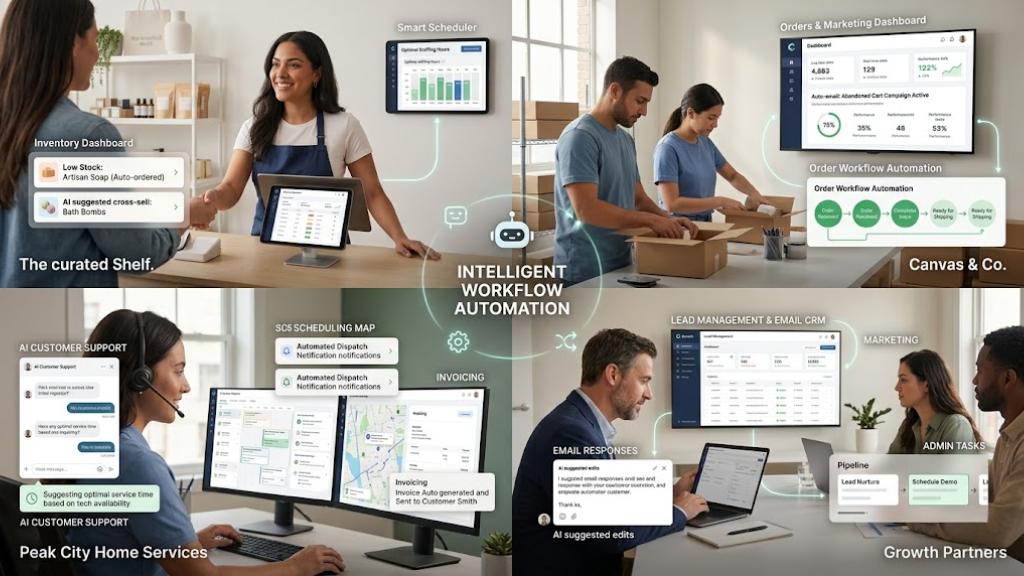
What Is AI Automation for Small Businesses? (Complete 2026 Guide)
Introduction
AI automation for small businesses is no longer a futuristic concept—it’s a practical solution that companies worldwide are using to improve efficiency, reduce costs, and scale faster. In simple terms, AI automation means using artificial intelligence to handle repetitive tasks without constant human involvement.
From chatbots answering customer queries to systems analysing sales data, AI is transforming
how small businesses operate.
Businesses working with firms like Global AI Group are increasingly adopting automation to stay
competitive in a rapidly evolving digital landscape.
What Is AI Automation?
AI automation combines artificial intelligence with workflow automation to perform tasks that
traditionally required human effort.
These tasks include:
- Customer support
- Data entry
- Email marketing
- Lead generation
- Sales forecasting
Unlike traditional automation, AI systems can learn, adapt, and improve over time, making
them far more powerful.
Why AI Automation Matters for Small Businesses
1. Saves Time
AI can handle repetitive tasks 24/7. This allows business owners to focus on strategy and growth instead of routine work.
2. Reduces Costs
Hiring employees for repetitive tasks can be expensive. AI tools offer a cost-effective alternative.
3. Improves Accuracy
AI reduces human error, especially in tasks like data processing and reporting.
4. Scales Easily
As your business grows, AI systems can handle increased workload without additional hiring.
Key AI Automation Tools for Small Businesses
AI Chatbots
Used for customer support and lead generation.
CRM Automation
Manages customer relationships and automates follow-ups.
Marketing Automation Tools
Help run email campaigns, ads, and customer segmentation.
Workflow Automation Platforms
Automate internal processes like approvals and reporting.
Real-Life Use Cases
- E-commerce: AI recommends products and handles customer queries
- Healthcare: Automates appointment scheduling
- Finance: Detects fraud and analyses transactions
- Marketing Agencies: Automates campaigns and reporting
How to Get Started with AI Automation
Step 1: Identify Repetitive Tasks
Look for tasks that consume time but don’t require creativity.
Step 2: Choose the Right Tools
Start with simple tools like chatbots or email automation.
Step 3: Integrate with Existing Systems
Ensure your AI tools work with your current software.
Step 4: Monitor and Optimise
Track performance and improve workflows over time.
Common Mistakes to Avoid
- Trying to automate everything at once
- Choosing tools without clear goals
- Ignoring staff training
- Not measuring ROI
Cost of AI Automation
- Basic tools: $20–$300/month
- Mid-level solutions: $500–$5000
- Custom AI systems: $10,000+
The investment is often justified by increased efficiency and revenue.
Future of AI Automation
AI automation will continue to evolve with:
- Smarter decision-making systems
- Voice-enabled automation
- Predictive analytics
Businesses that adopt early will have a major advantage.
Conclusion
AI automation is not about replacing humans—it’s about enhancing productivity and making better decisions. Small businesses that embrace AI today are setting themselves up for long-term success.